
The Great AI Divide: An Estimated AI Contribution to Economy by 2030
The global economy stands at an inflection point where artificial intelligence will contribute an estimated $15.7 trillion to GDP by 2030, yet this wealth remains concentrated amongst ten nations capturing 70-75% of total value creation.
Let us examine the structural forces driving the Great AI Divide, analyse the critical convergence areas where countries and companies must align their strategies over the next five years, and propose an actionable framework for managing this unprecedented technological and economic transformation.
Drawing upon industry data, academic research, and real-time market dynamics, we would argue that the window for inclusive AI development is rapidly closing—and the consequences of failure extend beyond economics into the realm of geopolitical stability and human dignity.
The Anatomy of Division: Understanding the Great AI Divide
The Great AI Divide is not merely a gap in technological capability—it represents a fundamental restructuring of global power, economic opportunity, and human potential. As we stand in October 2025, the contours of this divide have sharpened into stark relief.
The Geography of AI Wealth
Ten countries—the United States ($15.7 trillion), China ($12.56 trillion), Japan ($9.42 trillion), Germany ($7.85 trillion), the United Kingdom ($6.28 trillion), India ($4.71 trillion), France ($4.71 trillion), South Korea ($3.92 trillion), Canada ($3.14 trillion), and Australia ($2.35 trillion)—will capture approximately 70-75% of global AI value creation by 2030, according to projections from Digital Planet at The Fletcher School, PwC, and the Harvard Business Review. The remaining 150+ nations, home to billions of people, will share less than 25-30% of this economic transformation.
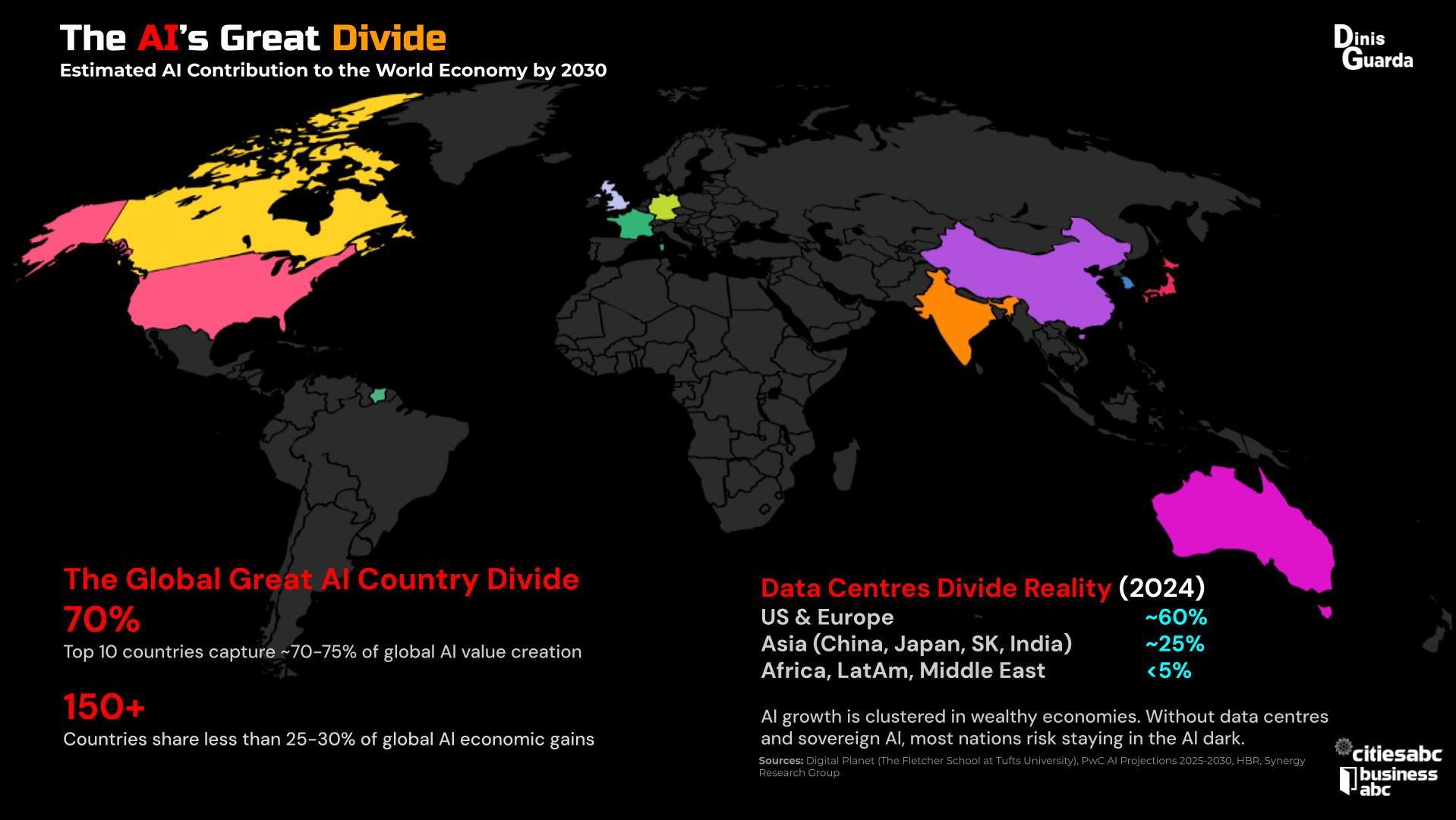
An infographic by Dinis GuardaThis is not abstract futurology. This is the architecture of the next decade taking shape before our eyes.
The infrastructure divide tells an even more sobering story. As of 2024, approximately 60% of global hyperscale data centres—the computational backbone of artificial intelligence—reside in the United States and Europe. Asia, led by China, Japan, South Korea, and India, hosts roughly 25%. The rest of the world—Africa, Latin America, the Middle East—combined controls less than 5% of this critical infrastructure.
Without data centres, without sovereign large language models, without computational resources, nations risk something worse than economic exclusion: they risk becoming digital colonies, where their raw data fuels AI models developed abroad whilst economic value flows in only one direction—outward.
The Corporate Crucible: Where Knowledge Work Meets Its Reckoning
Whilst nations grapple with infrastructure deficits, corporations face their own existential moment. The “crucible” concept, articulated in a 2023 Harvard Business Review article by GAI Insights co-founder Michael Beckley and colleagues, identifies organisations where knowledge work—words, images, numbers, and sounds (WINS)—dominates cost structures. These firms, spanning consulting, finance, software, and professional services, stand at the epicentre of AI disruption.
Accenture’s recent actions illuminate this reality with brutal clarity. Between June and August 2025, the global consulting giant eliminated 11,000 positions, reducing its workforce from 791,000 to 779,000. CEO Julie Sweet’s explanation during the September 25 earnings call carried the weight of an industry-wide verdict: “We are exiting on a compressed timeline, people where reskilling… is not a viable path for the skills we need.”
The paradox embedded in Accenture’s numbers reveals the complex nature of AI’s impact. Despite workforce reductions, the firm reported fiscal 2025 revenue of $69.7 billion—up 7% year-over-year—with generative AI bookings surging from $3 billion to $5.1 billion. The message reverberates across boardrooms globally: AI is expansionary for those who master it, but merciless to those who cannot adapt.
This pattern extends beyond consulting. PwC projects a one-third reduction in entry-level hires over three years—from 3,242 tax and assurance associates in fiscal year 2025 to 2,197 by 2028. Harvard Business School’s Class of 2025 witnessed roughly 20% of graduates jobless at commencement, as traditional consulting and investment banking hiring throttled in response to AI-driven efficiencies. Industries that once absorbed 56% of elite MBA graduates now offer placements at dramatically reduced rates: 38% for consulting, 18% for finance.
The World Economic Forum warns that 92 million roles face risk by 2030. Goldman Sachs estimates 300 million full-time equivalents could be automated, though they project net creation of 78 million new positions. McKinsey’s 2025 AI report reveals that 40% of employers anticipate workforce reductions where AI automates tasks, whilst 35% cite displacement as a primary concern.
Yet here lies the cruel arithmetic of our moment: 75% of knowledge workers already use AI tools, with productivity gains averaging 66%. The technology works. The question is whether we can ensure its benefits extend beyond the fortunate few.
Key Insight: AI is expansionary for those who adapt, but creates a “compressed timeline” for reskilling—those who cannot pivot face systematic exclusion from the future economy.
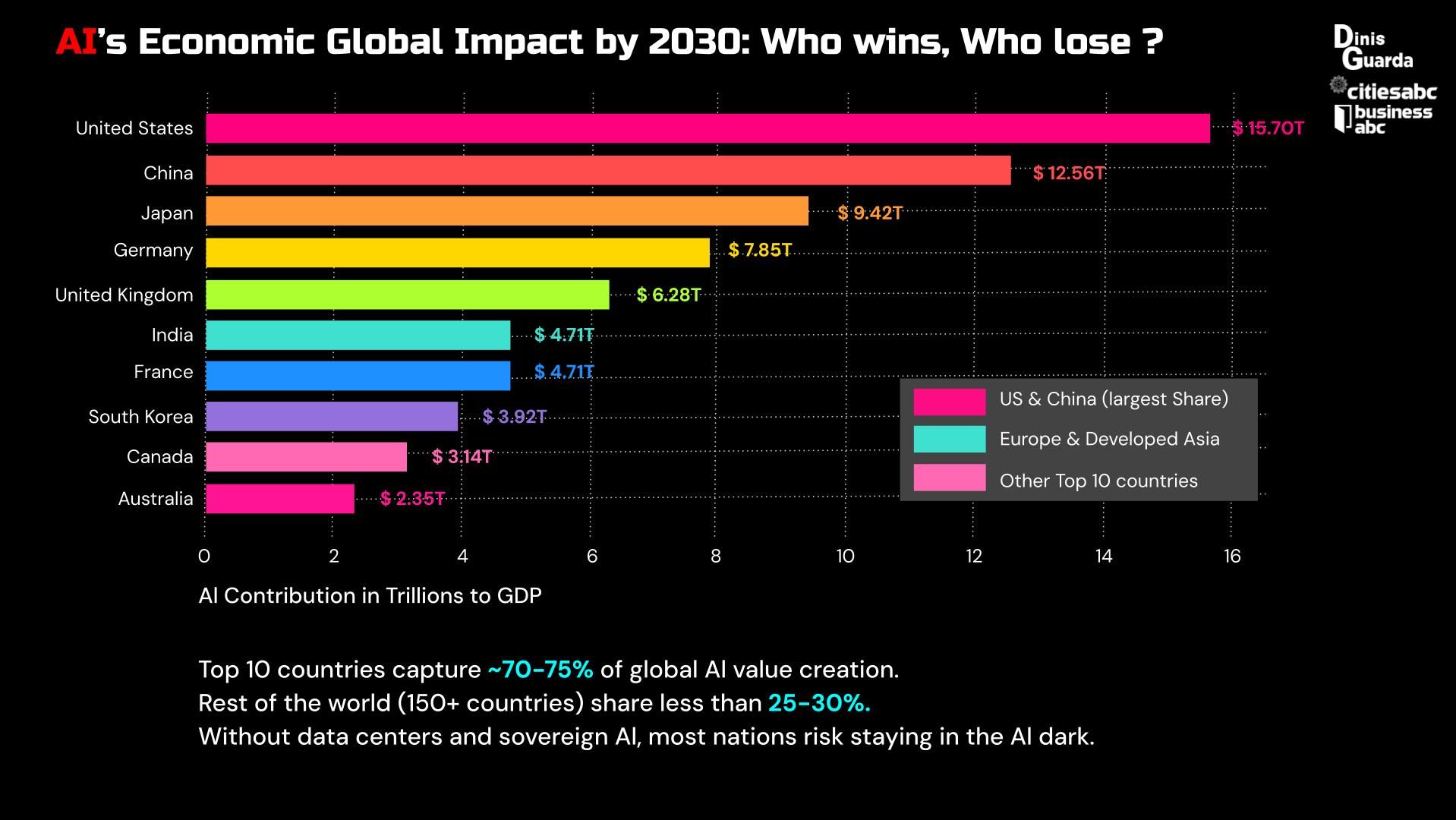
An infographic by Dinis Guarda
II. Five Critical Convergence Areas: Where Countries and Companies Must Align
The next five years will determine whether the Great AI Divide becomes a permanent feature of our global landscape or a challenge we collectively overcome. Five critical areas demand coordinated action between nations and corporations:
1. Infrastructure Sovereignty and Democratic Access
The Challenge: The concentration of computational infrastructure creates dependencies that mirror colonial resource extraction. Developing nations provide data—the raw material of AI—whilst lacking the infrastructure to process it into value.
The Imperative: Countries must invest in sovereign AI infrastructure whilst corporations must support distributed computational networks. This is not charity; it is enlightened self-interest. Markets cannot flourish where customers lack agency, and innovation cannot thrive in monocultures.
Strategic Actions for the Next Five Years:
For Countries:
- Establish national AI infrastructure funds targeting hyperscale data centre development in underserved regions
- Create regional computational cooperatives amongst neighbouring nations to share infrastructure costs
- Mandate data localisation requirements that incentivise domestic processing capacity
- Develop “AI corridors” connecting university research centres with commercial deployment zones
For Companies:
- Participate in hybrid public-private infrastructure initiatives that distribute computational capacity
- Open-source foundational models to enable local fine-tuning and development
- Establish edge computing networks that reduce dependence on centralised facilities
- Create technical assistance programmes for emerging market infrastructure development
Measurable Targets:
- Increase Global South data centre capacity from <5% to 15% by 2030
- Establish sovereign large language models in at least 50 additional countries
- Reduce latency for AI services in developing nations by 60%
The precedent exists. China’s Belt and Road Initiative, whatever its geopolitical implications, demonstrated that infrastructure development at scale remains possible. The question is whether democratic nations and responsible corporations can mount an equivalent response focused on digital infrastructure.
2. Workforce Transformation and Continuous Reskilling
The Challenge: The skills required for AI-augmented work evolve faster than traditional education systems can adapt. PwC’s 2025 Global AI Jobs Barometer, analysing nearly one billion job advertisements across six continents, reveals that skills demands in AI-exposed sectors have shifted 40% since 2022, with 77% of new AI roles requiring master’s degrees.
The Imperative: We face a choice between mass displacement and mass empowerment. The difference lies in our commitment to continuous reskilling at unprecedented scale and speed.
Strategic Actions for the Next Five Years:
For Countries:
- Implement national AI literacy programmes targeting 100% of workforce within three years
- Extend unemployment benefits and training stipends for displaced workers, following China’s model of extended unemployment incentives through 2025
- Mandate AI fundamentals in secondary education curricula
- Create tax incentives for companies investing in employee reskilling
- Establish “AI transition zones” providing intensive retraining for displaced knowledge workers
For Companies:
- Scale reskilling initiatives to cover entire workforces, following Accenture’s model of training 550,000 employees on generative AI fundamentals
- Develop clear AI-augmented career pathways showing evolution rather than elimination of roles
- Create internal AI communities fostering peer learning and tool sharing
- Implement “AI sabbaticals” allowing employees dedicated time for intensive upskilling
- Partner with universities to provide advanced credentials for mid-career professionals
Measurable Targets:
- Train 120 million workers globally in AI fundamentals within three years (per McKinsey estimates)
- Reduce AI skills gap by 50% across all sectors by 2028
- Increase female participation in AI roles from current 55% to 60%
- Establish minimum AI literacy standards for all knowledge work positions
The urgency cannot be overstated. Goldman Sachs projects 15% productivity gains for AI-adapted workers, whilst those without AI literacy face displacement rates approaching 30% in knowledge-intensive sectors. The question isn’t whether to invest in reskilling—it’s whether we can move fast enough to stay ahead of technological change.
3. Ethical Frameworks and Governance Structures
The Challenge: AI development has outpaced our governance mechanisms. Without coordinated ethical frameworks, we risk algorithmic bias at scale, surveillance capitalism, and the erosion of human agency.
The Imperative: Trust is the foundation of adoption. Without ethical guardrails, AI becomes a source of fear rather than empowerment, slowing beneficial deployment whilst harmful applications proliferate unchecked.
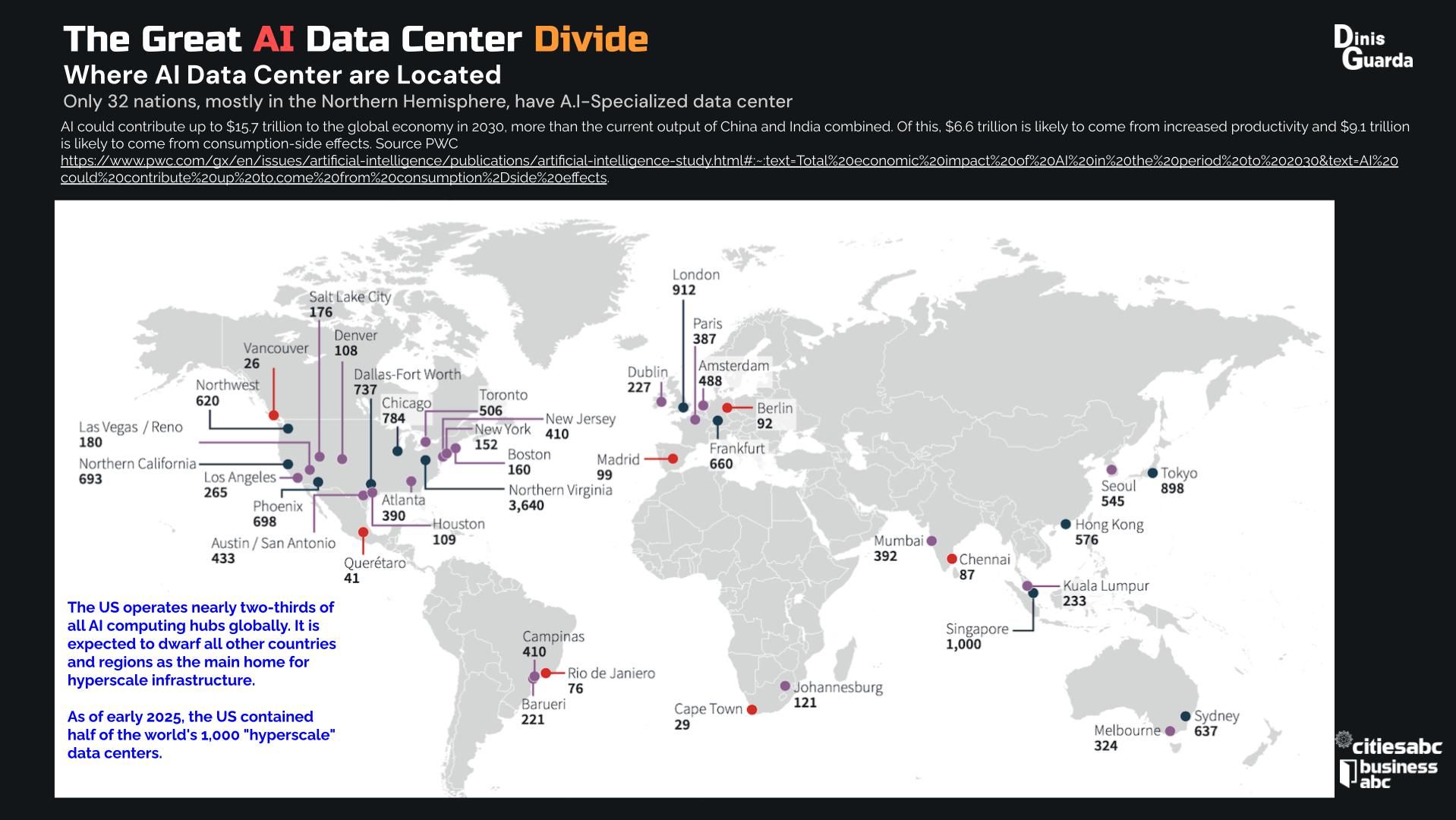
An infographic by Dinis GuardaStrategic Actions for the Next Five Years:
For Countries:
- Harmonise AI regulations across trading blocs to prevent regulatory arbitrage
- Establish international AI ethics tribunals with enforcement mechanisms
- Mandate algorithmic transparency and bias auditing for high-impact applications
- Create “AI impact assessments” similar to environmental impact statements
- Develop cross-border data governance frameworks balancing privacy with innovation
For Companies:
- Implement AI ethics boards with diverse representation and veto power
- Publish regular algorithmic bias audits and remediation efforts
- Adopt explainable AI practices for consumer-facing applications
- Establish clear human oversight mechanisms for automated decisions
- Create whistleblower protections for employees raising AI ethics concerns
Measurable Targets:
- Achieve international agreement on core AI ethical principles by 2027
- Reduce algorithmic bias incidents by 60% through mandatory auditing
- Establish clear liability frameworks for AI-generated harms
- Create standardised AI impact disclosure requirements
The European Union’s AI Act provides a template, but implementation lags intention. The next five years demand movement from principles to practice, from aspiration to accountability.
4. Innovation Ecosystems and Knowledge Transfer
The Challenge: AI innovation concentrates in a handful of technology hubs—Silicon Valley, Beijing, London, Tel Aviv—creating brain drain from emerging markets and reinforcing existing disparities.
The Imperative: Innovation thrives on diversity. Homogeneous development produces homogeneous solutions, leaving vast swathes of humanity’s needs unaddressed.
Strategic Actions for the Next Five Years:
For Countries:
- Establish AI research centres in emerging markets with competitive funding
- Create reverse brain drain incentives attracting diaspora talent home
- Develop “AI special economic zones” offering regulatory sandboxes and tax advantages
- Fund translation of AI research and educational materials into local languages
- Build partnerships between leading AI nations and emerging markets
For Companies:
- Establish distributed research and development centres in underserved regions
- Create technology transfer programmes sharing non-competitive AI capabilities
- Fund AI entrepreneurship in emerging markets through venture arms
- Develop products addressing local needs in underserved markets
- Create mentorship programmes connecting AI leaders with emerging market innovators
Measurable Targets:
- Establish 100 world-class AI research centres in emerging markets by 2030
- Increase AI patent filings from developing nations by 200%
- Create 500,000 AI jobs in currently underserved regions
- Achieve 30% of AI venture funding flowing to non-traditional hubs
India’s emergence as an AI powerhouse, projected to contribute $4.71 trillion to GDP by 2030, demonstrates that catch-up growth remains possible. The question is whether we can replicate this success across Africa, Latin America, and Southeast Asia—or whether India represents the exception that proves the rule.
5. Financial Mechanisms and Investment Frameworks
The Challenge: AI requires massive capital investment—in infrastructure, in training, in research—precisely when many nations face fiscal constraints and companies face margin pressure.
The Imperative: Without innovative financing, the Great AI Divide becomes self-reinforcing: wealthy nations and corporations invest in AI, reap productivity gains, accumulate more capital, and invest further—whilst others fall progressively behind.
Strategic Actions for the Next Five Years:
For Countries:
- Create sovereign AI investment funds capitalised through targeted taxation on AI-generated productivity gains
- Establish international AI development banks analogous to World Bank infrastructure financing
- Implement progressive taxation on AI productivity gains to fund transition programmes
- Develop public-private partnership models for AI infrastructure investment
- Create risk-sharing mechanisms reducing private sector investment barriers
For Companies:
- Establish AI venture funds targeting emerging market opportunities
- Develop revenue-sharing models allowing broader stakeholder participation in AI gains
- Create AI productivity bonds allowing workers to share in automation benefits
- Implement progressive compensation structures rewarding AI-augmented productivity
- Support international financing initiatives through concessional lending
Measurable Targets:
- Mobilise $500 billion in AI development financing for emerging markets by 2030
- Establish AI investment funds in 100+ countries
- Create self-sustaining financing mechanisms reducing dependence on aid
- Achieve 20% of global AI investment flowing to currently underserved regions
Accenture’s $865 million restructuring programme generated $1 billion in savings for AI reinvestment. This pattern—destroying value in old systems to create value in new ones—must be managed to ensure displaced workers and excluded nations share in the benefits, not just bear the costs.
III. A Framework for Managing the Great AI Divide
Understanding the problem and identifying convergence areas represents necessary but insufficient progress. We require an actionable framework—a strategic architecture for managing the Great AI Divide over the next five years.
The WINS Reinvention Framework
Building upon the WINS concept (Words, Images, Numbers, Sounds) introduced in Harvard Business Review, we propose the WINS Reinvention Framework for coordinated action:
W – Workforce Transformation at Scale
- Immediate: Launch national AI literacy campaigns reaching 50% of workforce within 18 months
- Near-term: Establish continuous learning platforms providing accessible AI education
- Medium-term: Restructure education systems around AI-augmented learning
- Long-term: Create lifelong learning entitlements funding continuous reskilling
I – Infrastructure Democratisation
- Immediate: Map computational infrastructure gaps with granular precision
- Near-term: Launch regional data centre development initiatives
- Medium-term: Establish sovereign AI capabilities in all G20 nations
- Long-term: Create truly distributed global AI infrastructure reducing concentration
N – New Social Contracts
- Immediate: Extend unemployment benefits and training support for displaced workers
- Near-term: Implement AI productivity sharing mechanisms
- Medium-term: Restructure tax systems capturing AI-generated value for broad-based investment
- Long-term: Develop new models of work and contribution in an AI-abundant economy
S – Sustainable Innovation Ecosystems
- Immediate: Fund AI research in underserved regions
- Near-term: Create technology transfer mechanisms democratising AI capabilities
- Medium-term: Build world-class AI research centres in emerging markets
- Long-term: Achieve truly global innovation networks where talent matters more than geography
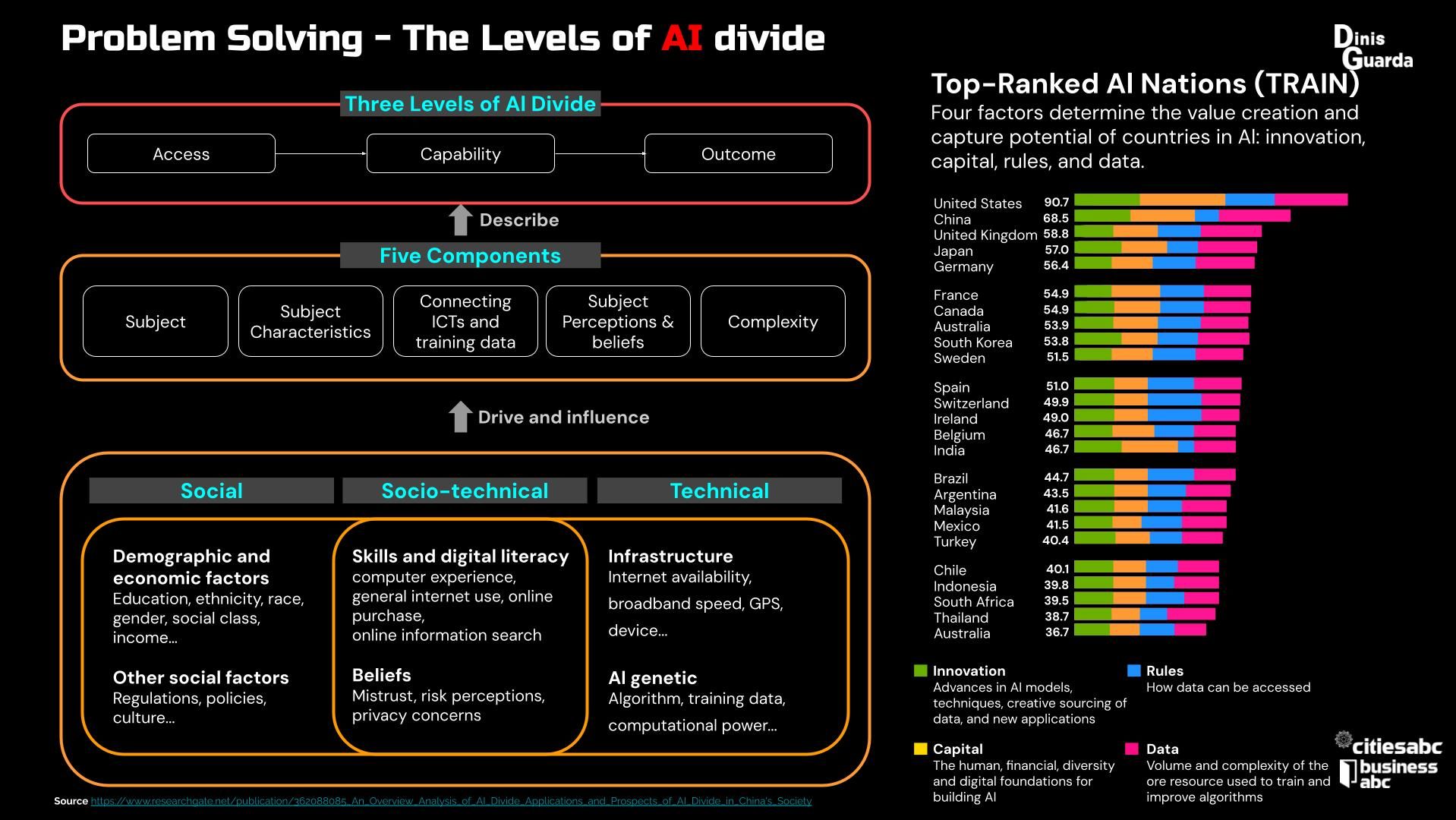
An infographic by Dinis GuardaThe Convergence Mechanism: Four Pillars of Coordination
Effective management of the Great AI Divide requires coordination across four pillars:
Pillar 1: Multilateral Governance
- Establish an International AI Coordination Council bringing together nations, corporations, civil society, and academia
- Create binding commitments on infrastructure development, workforce transition, and ethical deployment
- Develop enforcement mechanisms with real consequences for non-compliance
- Build consensus around shared metrics tracking progress towards convergence
Pillar 2: Market Mechanisms
- Implement AI productivity taxes creating funds for transition programmes
- Develop international AI bonds financing infrastructure in emerging markets
- Create certification systems rewarding companies demonstrating inclusive AI practices
- Establish carbon-credit-style systems incentivising AI capability transfer
Pillar 3: Corporate Responsibility
- Move beyond voluntary initiatives to binding corporate commitments
- Establish stakeholder governance structures giving workers and communities voice in AI strategy
- Create transparency requirements for workforce planning and displacement
- Develop revenue-sharing models distributing AI gains beyond shareholders
Pillar 4: Civil Society Engagement
- Empower labour organisations to negotiate AI transition terms
- Fund independent AI ethics organisations providing oversight
- Create civic participation mechanisms in national AI strategies
- Build public understanding through education and transparent communication
IV. The Urgency Imperative: Why the Next Five Years Matter
Time collapses when technologies mature at exponential rates. The next five years represent our window for inclusive AI development—after which path dependencies may lock in current disparities for generations.
The Acceleration Factor
AI capabilities double approximately every six months according to recent benchmarks. This means the AI of 2030 will be orders of magnitude more capable than today’s systems. If current concentration patterns persist, this exponential improvement benefits only those already positioned to capture value—whilst the gap between haves and have-nots grows not linearly but exponentially.
PwC’s analysis reveals that AI-exposed sectors already grow revenue per employee three times faster than others—but only for workers who adapt. This multiplier effect means that even modest initial advantages compound rapidly. A nation or company that starts five years behind may find itself effectively a generation behind when measured in capability terms.
The Window of Plasticity
Technological systems exhibit periods of plasticity—windows during which their trajectory remains malleable—before hardening into path-dependent structures resistant to redirection. The personal computer industry crystallised around Wintel architecture. Mobile computing coalesced around iOS and Android. Social media consolidated around a handful of platforms.
AI currently remains in its plastic phase. Foundational models can still be challenged. Infrastructure patterns can still be shifted. Business models remain experimental. But this window closes rapidly. Within five years, we may face AI systems too entrenched, too capital-intensive, too complex to meaningfully redistribute or democratise.
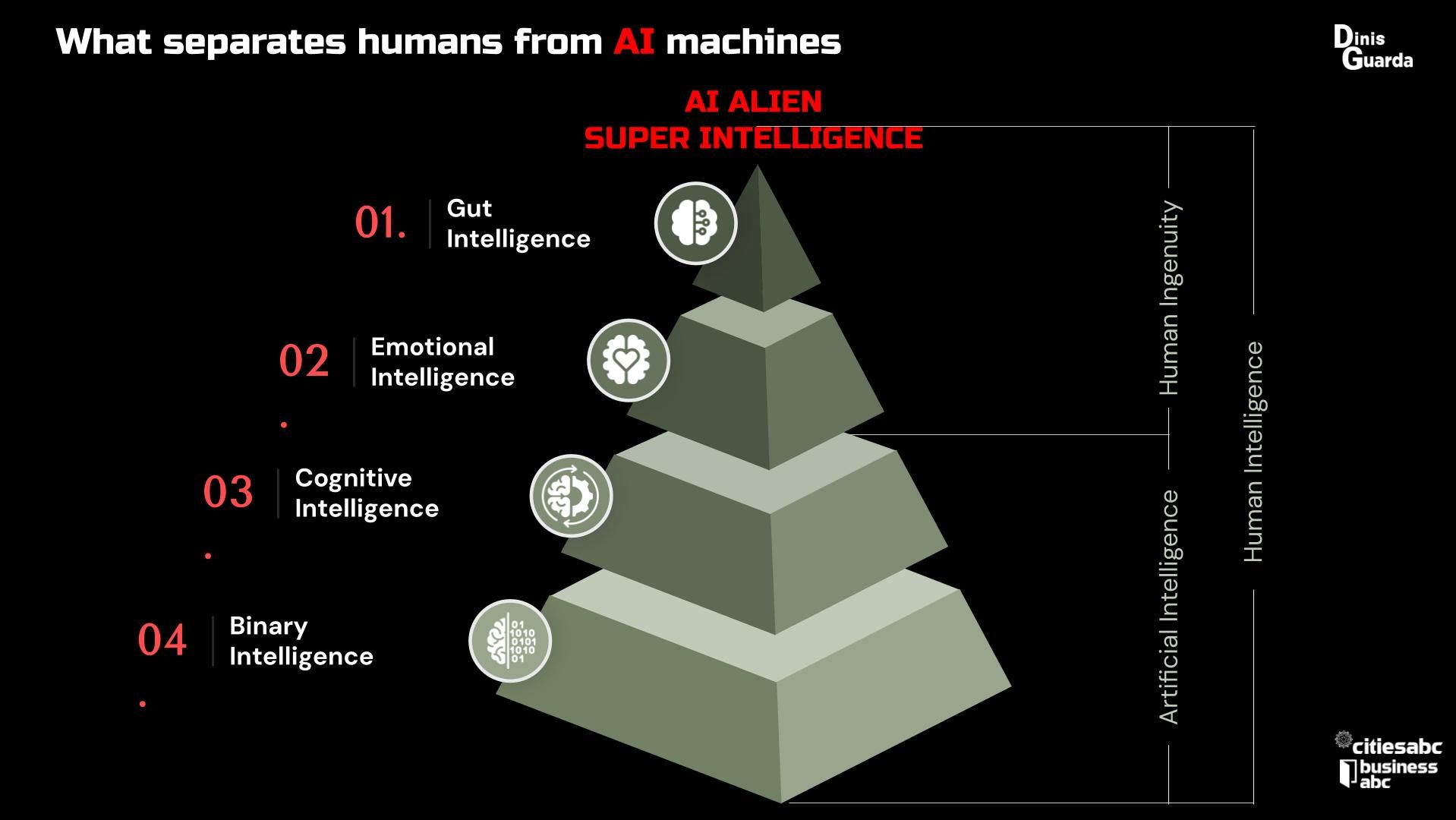
An infographic by Dinis GuardaThe Social Stability Threshold
Beyond economics lies a starker concern: social stability. The Rust Belt’s decline and the opioid crisis emerged from economic displacement an order of magnitude smaller than what AI portends. We contemplate 92 million displaced roles according to the World Economic Forum, 300 million automated positions per Goldman Sachs, with particular concentration amongst knowledge workers who believed themselves immune to technological disruption.
Cities risk becoming “Youngstown 2.0″—knowledge hubs hollowed by AI offshoring and automation. Harvard Business School graduates facing 20% jobless rates at commencement signal a crisis of expectations meeting reality. When societies promise education as the path to prosperity, then automate the educated professions, they breach a fundamental social contract.
The next five years determine whether we manage this transition deliberately or allow market forces alone to dictate outcomes. History suggests that technological unemployment unmanaged by policy produces not efficient reallocation but social upheaval.
The Geopolitical Dimension
The Great AI Divide is also a great power competition. Nations that achieve AI supremacy will dominate the 21st century economically, militarily, and culturally. Current concentration patterns—with the United States and China capturing nearly half of global AI value—create a bipolar world that excludes the vast majority of humanity from agency in shaping our collective future.
This concentration breeds resentment and instability. It creates dependencies that can be weaponised. It produces AI systems trained predominantly on Western and Chinese data, embedding those cultural assumptions into systems deployed globally.
The next five years offer an opportunity for multilateral cooperation—for building truly global AI systems reflecting human diversity. Miss this window, and we may face decades of AI neo-colonialism, with all the instability that implies.
V. From Analysis to Action: An Urgent Call for Strategic Alignment
We stand at a threshold that demands something remarkable from this generation: the wisdom to see beyond immediate advantage towards collective flourishing, the courage to restructure systems that benefit some of us but fail many of us, and the urgency to act whilst action remains possible.
Critical Insight: Every stakeholder has agency and responsibility. Inaction by any group undermines collective success.
For National Leaders
The next five years require statesmanship of the highest order. You must:
- Recognise AI infrastructure as critical national security on par with energy and food systems
- Invest in your citizens through the largest reskilling programmes in human history
- Build international cooperation frameworks that transcend traditional geopolitical competition
- Create safety nets robust enough to manage unprecedented economic transition
- Legislate ethical frameworks before harmful practices become entrenched
The political courage required cannot be understated. These investments demand resources and attention during periods of fiscal constraint and political polarisation. But the alternative—managing the social instability of mass technological unemployment and widening global inequality—carries costs that dwarf preventive investment.
For Corporate Leaders
You face a choice between short-term optimisation and long-term sustainability. Companies that pursue AI-driven productivity whilst ignoring workforce transition and societal impact may reap immediate gains—but they build on foundations of sand.
Your mandate over the next five years:
- Scale reskilling to cover entire workforces, not just identified high-performers
- Participate in infrastructure development initiatives beyond your immediate geographic markets
- Adopt stakeholder governance giving workers and communities voice in AI strategy
- Support international agreements on ethical AI development and deployment
- Share non-competitive AI capabilities through technology transfer programmes
The alternative—a world where AI benefits concentrate amongst shareholders whilst workers and communities bear transition costs—is not sustainable economically or politically. Markets require customers with purchasing power. Societies require legitimacy built on shared prosperity.
For Every One of Us
If you are a knowledge worker, the next five years demand continuous learning on a scale unprecedented in your career. AI literacy is no longer optional. The productivity gains averaging 66% accrue to those who master AI augmentation—whilst those who resist face displacement rates approaching 30%.
If you are a parent, recognise that the career paths that defined previous generations may not exist for your children. The half-life of skills continues to shrink. Education must become continuous rather than front-loaded into youth.
If you are a citizen, demand that your leaders address AI transition with the seriousness it deserves. Support investments in infrastructure, reskilling, and safety nets even when they require difficult fiscal trade-offs.