

The Egyptian pantheon is not a museum of dead gods. It is a mirror of the human soul.
→ Read the full piece: The Powerful Gods of Egypt — The First Human Mythology
Egypt is where the human imagination first built a universe — and then dared to live inside it.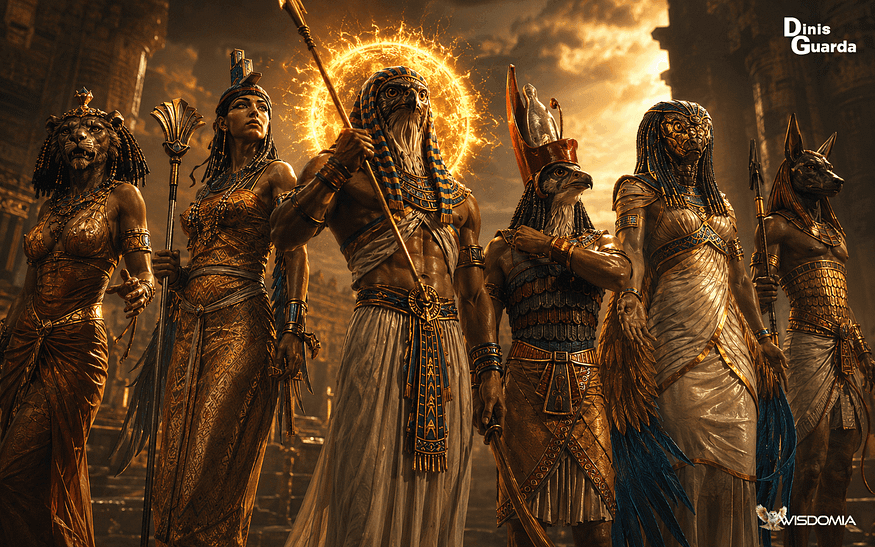
Other peoples had gods before Egypt. But Egypt was the first civilisation to take the scattered intuitions of the human heart and forge them, over thirty consecutive centuries, into a single, coherent architecture of the sacred. The deep conviction that the sun is a perilous voyage and not a mere lamp. That death is a threshold and not an absolute wall. That justice is a measurable cosmic weight, not a comforting wish.
When we speak of the first great, fully integrated mythology of our species, we are speaking — with the material evidence in our very hands — of the gods of the Nile.
A Pantheon That Looks Back at You
The gods of Egypt were never arbitrary. Ra is our structural hunger for cosmic order, and our daily courage to begin again after the dark. Osiris is our grief, our vulnerability to brokenness, and our refusal to let the beloved dead simply disappear. Isis is supreme intelligence bent entirely to the work of love. Thoth is the part of us that writes, counts, and remembers against the tide of time.
Each divine face is not a foreign idol — it is a distinct faculty of the human soul, given form and name for the first time.
The Democratic Revolution of the Afterlife
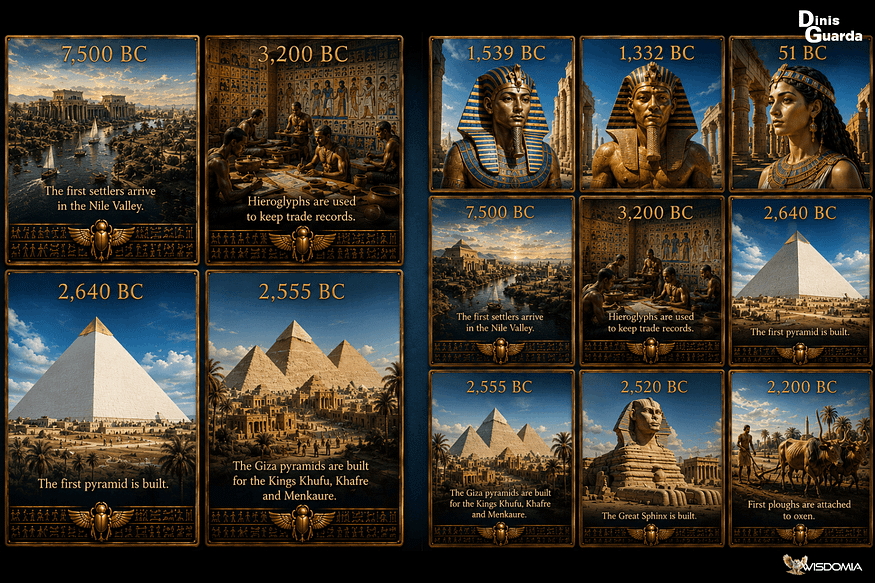
One of the most quietly radical moments in human history happened around 2130 BCE, when catastrophic Nile floods shattered Egypt’s political order. What emerged from the chaos was extraordinary: if the pharaoh could achieve eternal life through sacred texts, why not the common citizen?
The exclusive Pyramid Texts were democratised onto the wooden interiors of ordinary coffins. Any individual who could afford a proper burial could now transform into Osiris upon death — regardless of royal blood. The afterlife became, for the first time, a universal inheritance.
We Are Still Thinking in Hieroglyphs

This mythology did not die when the last hieroglyph was carved at Philae. The image of Isis holding Horus provided the visual prototype for the Madonna and Child. The Greek philosophical concept of the Logos echoes the ancient Memphite Theology, in which the creator god Ptah spoke the universe into existence. The obelisk still punctuates modern city squares.
We are, in structural ways we rarely notice, still thinking in hieroglyphs.
This is only the beginning of the journey.
The full atlas — covering the complete divine family tree, the ten great gods in depth, the sacred animal code, the technology of mummification, and the living world of Egyptian ritual — is published on Wisdomia.
→ Read the full piece: The Powerful Gods of Egypt — The First Human Mythology